How the Internet Discovered Liminal Spaces
It started with one Tumblr post about an empty swimming pool. It ended with an entire aesthetic movement, a horror subgenre, two Reddit communities with millions of subscribers, and a word most people didn't know five years ago showing up in architecture school syllabuses. Here's how that happened.
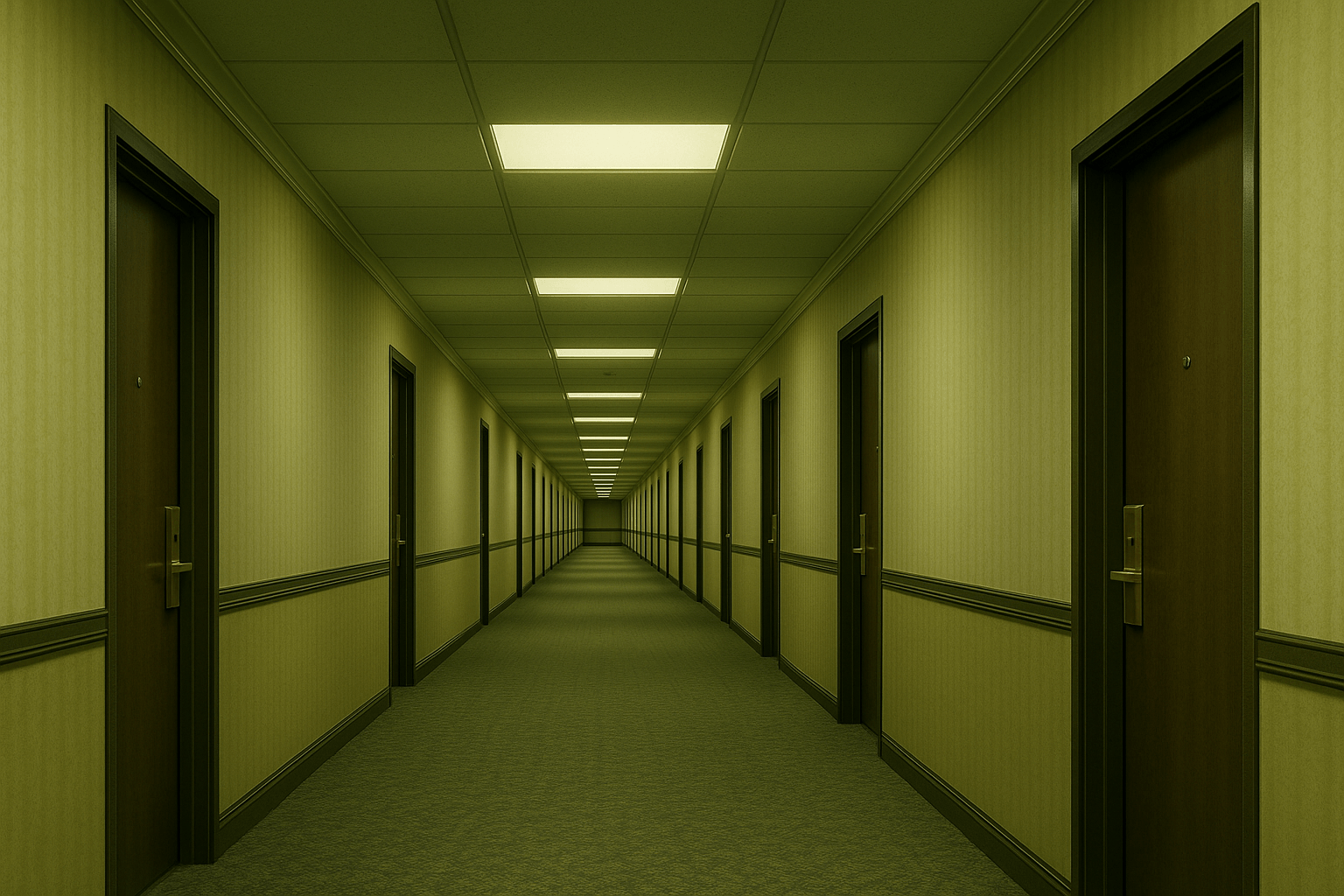
In 2009, a philosopher named Marc Augé published a book about "non-places" — airports, motorway service stations, hotel lobbies. Spaces designed for transit rather than habitation. He didn't use the phrase liminal spaces, but he was circling the same territory. His book got a moderate academic readership and very little internet presence. Then the internet went and did the thing it does.
The word "liminal" comes from the Latin limen, threshold. In anthropology it describes transitional states — the moment between old identity and new one. Van Gennep used it in 1909. Victor Turner developed it in the 1960s. Then, sometime around 2019, it became the name for a specific feeling about empty corridors and off-hours grocery stores.
Here's the thread.
The Pool Rooms (4chan, 2009)
The origin story most people cite is a 4chan /x/ post from 2009 — a photograph of an empty indoor swimming pool with yellow-green water and fluorescent lighting, captioned with a short paragraph about being somewhere you weren't supposed to be. The post framed the image not as a location but as a feeling: the specific unease of an institutional space without people in it. The photograph went nowhere in particular, but the framing stuck around in the corners of the internet that collect such things.
OriginTumblr Aesthetics (2013–2018)
Tumblr in its prime was an extraordinary machine for naming feelings that didn't have names yet. Between 2013 and 2018, a loose constellation of blogs began collecting and tagging photographs of empty spaces — hotel corridors at 3am, airport terminals after the last flight, school hallways on weekends. The tags varied: "dreamcore," "weirdcore," "nostalgiacore," "backrooms." No single name had won yet. But the subject matter was consistent: places that exist to be passed through, photographed at the moment of emptiness that reveals their real character.
Aesthetic FormationThe Backrooms (4chan, May 2019)
In May 2019, a single image appeared on a 4chan thread asking users to post "disquieting images." The image showed a hallway of yellow-tinged carpet, fluorescent lighting, and no doors — clearly a real photograph of an office or hotel mid-renovation, taken with a slightly wrong camera angle. The original poster added a caption: "If you're not careful and you noclip out of reality in the wrong areas, you'll end up in the Backrooms." That sentence launched an entire fictional cosmology. Within weeks, collaborative fiction about the Backrooms was appearing on Reddit, on wikis, on YouTube. The image was doing something the earlier pool photographs had done — but someone had finally given it a narrative hook.
The Sparkr/LiminalSpace (Reddit, 2019–2022)
The subreddit r/LiminalSpace was created in 2019 and grew slowly until around 2020, when it exploded — reaching two million subscribers by 2022. The community settled on a working definition: spaces that feel transitional, empty of people, suspended between one thing and another. Not necessarily disturbing. Sometimes melancholy. Sometimes oddly peaceful. The subreddit's strict moderation kept out horror-adjacent content and focused on the aesthetic: images had to be real photographs, not AI-generated, not digitally altered. This distinction would become harder to maintain.
CommunityThe SCP Foundation and Collaborative Horror
The SCP Foundation is a collaborative fiction wiki that has been running since 2008, collecting "anomalous objects and entities" in a fictional bureaucratic format. By 2020, a significant portion of new SCP entries were liminal-space adjacent — entities that existed in empty parking garages, spaces accessible only through specific architectural transitions, the horror of a place that should contain people containing none. The Backrooms mythology formally merged with SCP aesthetics in various fan works, creating a feedback loop between the two communities. What had started as an image of carpet was now a fully developed fictional multiverse with maps, taxonomies, and canonical lore.
Fictional ExpansionKane Pixels and the YouTube Horror Moment (2022)
In January 2022, a teenager called Kane Pixels uploaded "The Backrooms (Found Footage)" to YouTube. The video used careful VFX to render the Backrooms as a found-footage horror short, and it hit ten million views in days. It is technically impressive, but what's more interesting is what it revealed about the aesthetic's latent power: presented as video, the liminal space feeling that photographs had been gesturing at for a decade became visceral in a new way. The comment sections filled with people describing the feeling the video gave them — not fear exactly, but a kind of déjà vu, a recognition of something they'd felt in real spaces.
Mainstream MomentArchitecture School and the Academic Reclamation
By 2023, architecture and urban design academics had begun writing seriously about the aesthetic — tracing it back to Augé's non-places, to Gordon Matta-Clark's building cuts, to the psychogeography of the Situationists. A vocabulary that had developed entirely in internet communities, through 4chan posts and Reddit moderation policies and YouTube comments, was being absorbed into the academic frameworks it had independently rediscovered. The word "liminal" had completed an unusual journey: from anthropology to Tumblr to Reddit to YouTube to architecture school, arriving back in academia changed by everything it had picked up along the way.
Feedback LoopWhere the hole leads
Keep pulling this thread and you end up in several interesting directions at once. There's the broader question of how internet communities name feelings — the aesthetic pipeline from Tumblr tagging to Reddit community-building to mainstream recognition. There's the specific question of why empty institutional spaces hit differently than empty natural spaces (short answer: they're designed for human presence, so absence reads as wrong). And there's the AI angle: once image generators got good, r/LiminalSpace faced a moderation crisis around AI-generated photographs that looked liminal but weren't real. The community's decision about how to handle that is a small, specific case study in how online communities negotiate authenticity — and it's still playing out.